 Photos – Jamie Williams
The Wider Earth is an astonishing show, a fictionalised retelling of the profoundly important story of Charles Darwin’s discoveries while voyaging on The Beagle, which led him to the principle of Natural Selection, the foundation of our modern understanding of evolution. Yet it is how the production goes about presenting this, one of the most important revelations in human history, which elevates the show into a truly special theatrical experience.
Primarily covering the five years Darwin spent with The Beagle, this innovative staging uses an immersive and visually spectacular collection of techniques to bring the incredible vistas, changing terrain and scenes of life aboard a tall ship to the stage, although nothing comes to life quite as memorably as the wide variety of creatures Darwin studies as a budding naturalist and reluctant geologist. A combination of using digital imagery projected onto a wide strip of screen behind the action, with a rotating wooden set that dominates the centre of the stage, creates a constantly changing sense of location and conditions for the action.
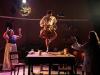
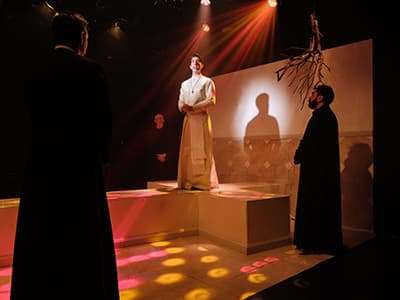
A high, blocky structure made of hard colliding angles, the set turns to different sides to create the many scenarios required, such as a stately country manor, a professor’s office, the deck or interior of the ship, the top of a mountain ridge or the slope of a hill on the Galapagos islands. The projections backing the action are perfectly orchestrated to enhance atmosphere without overly drawing the eye enough to prove distracting, largely showing maps of the locations covered, or partially animated images of costal or jungle environments. Excellent sound and lighting design complete the illusion, enhanced by a score provided by Lior.
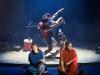
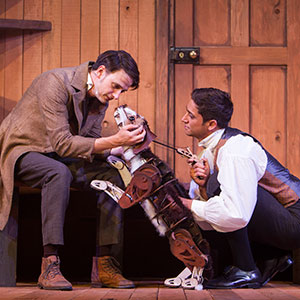
Yet without question the most striking and enchanting element of this production is the extensive use of puppetry to bring to life the menagerie of creatures Darwin rigorously studies on his journey, and by observing them develops his historic theory. Seemingly constructed largely out of wood, springs, and gears, with the occasional inclusion of feathers and fur, these life-sized articulated puppets have a somewhat skeletal appearance not dissimilar to the steeds used in the blockbuster stage show War Horse that toured several years ago. This imparts a striking look to the creatures, almost that of imagined “Steampunk” Victorian robotics, yet also oddly conveying a strong sense of anatomy and functionalism, almost as though the creatures were walking, crawling and flying studies of the physical mechanics of life.
Puppeteered by the actors themselves, largely with rods and articulating levers, everything from cooing pigeons, slithering lizards, rolling armadillos, diving finches, giant leaf-munching Galapagos turtles, and Darwin’s own adorable yapping pet beagle are rendered wonderfully animate. It is also captivatingly fascinating, as we see these creatures as through the eyes of a man in a state of constant discovery.
The narrative itself is very powerful, taking us through the steps by which Darwin began to question the strange similarities and variations found in animals living geographically far apart and in apparent isolation. These observations spur his burgeoning concept that would challenge creationist orthodoxy that all creatures exist unchanging, in the same forms that God first put them upon the earth.
The play does a nice job of laying the seeds of this idea early on, in showing Darwin’s strained relationship with his father, who breeds pigeons in captivity. Years later while on his voyage, it is in drawing comparison to his father’s use of selective breeding to create a new variety of bird that is the Eureka moment for young Charles, theorising that a similar process to man’s use of animal husbandry could play out in nature. That a persistence of those variations in characteristics which are most conducive to perpetuating life – and thus those which in turn drive gradual generational change – serve as the bedrock for the “survival of the fittest” concept, his breakthrough hypothesis of natural selection.
The play is not concerned with this monumental discovery alone, but also its context and consequences. They establish Darwin as a young man drifting through life, leaving many safer opportunities his father would prefer by the wayside, notably a career in the clergy. He even leaves his beloved would-be fiancée Emma behind for the opportunity to pursue science and adventure. He seems ill-suited to the task at first, being underqualified for what is a largely geological survey on a mapping voyage, with an unofficial missionary detour to Tierra del Fuego. This was due to Captain Fitzroy’s obsession with redeeming the proselytising objective of his previous captain, who had taken his own life.
Crises of faith are rife throughout this play, with not only Captain Fitzroy, but also the eventually suicidal preacher onboard who fails in his goal to evangelise the “savages”, and then ultimately Darwin himself, who realises that the truth of his discoveries could destabilise accepted religious tenets. Not wanting to “be the man who killed God”, Darwin attempts to abandon his work, before finally accepting his destiny to devote the rest of his life to developing this nascent branch of science.
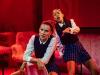
With a strong ensemble cast, several of whom double as multiple characters in addition to serving as puppeteers, the play is ultimately anchored by the strong central performance of Tom Conroy, recently seen it a shattering production of Nineteen Eighty-Four. Conroy does a remarkable job as the young Charles Darwin, perfectly conveying the wide range of emotions from boyish delight through intellectual grappling and existential terror at the implications of his brilliant deductions. He interacts masterfully with the range of mentors, antagonists and companions throughout his remarkable journey. Yet the highest praise for the show must go to David Morton, the writer, director, co-designer and puppet designer of this lush, engrossing production. Morton orchestrates remarkable visuals and complex scenic elements in perfect balance with its focus on character, story, and one big, history-changing idea.
A breathtaking night at the theatre, not to be missed.
Queensland Theatre and Dead Puppet Society/Sydney Festival presents
The Wider Earth
by David Morton
Director David Morton
Venue: Drama Theatre | Sydney Opera House, Bennelong Point Sydney NSW
Dates: 17 – 27 January 2018
Tickets: $69 – $53
Bookings: 02 9250 7777 | www.sydneyfestival.org.au